
Why same-day documentation, 48-hour correction tracking, structured addendums, and significant change workflows now matter
Written by Ramon Sanchez, Founder & CEO of HospiceWorks
California’s new Title 22 hospice regulations are not just another documentation update.
They are changing the standard for what a hospice EMR must be able to prove.
For years, many hospice documentation workflows were built around flexibility. A clinician could complete a visit, save a note as a draft, finish it later, and rely on QA or a supervisor to catch missing items after the fact. In many systems, that review process depended on sending documentation back for edits, corrections, or late updates.
California’s new Title 22 requirements create a very different compliance environment.
The question is no longer only whether the note exists.
The question is whether the system can prove what happened, when it happened, who documented it, when an error was discovered, when it was corrected, whether the correction was authenticated, whether an addendum was distinct and traceable, and whether a significant change triggered the required follow-up.
That is a major shift for California hospice agencies.
The Old Documentation Model Is Under Pressure
Many hospice EMRs were designed around a traditional draft, review, edit, and submit workflow.
That model creates risk when documentation rules become more time-sensitive and more audit-driven.
Under California Title 22, clinical notes must be dictated or written on the day of service by the personnel providing the service. Clinical notes must also include a concise and accurate record of care and services, coordination of services, documented observations, and changes to the patient’s condition or needs.
This raises the stakes for documentation timing.
If a clinician waits too long to complete documentation, the agency may have a timing issue. But if the clinician signs quickly and QA discovers a problem days later, the agency now needs a clear correction and addendum process that can be defended during survey.
Corrections Are No Longer Just Edits
California Title 22 requires hospices to protect the integrity of the medical record.
The regulation states that entries regarding care or services must not be altered without a written explanation. If authorized hospice personnel make a medical-record entry error or alter an entry, the correction must document the reason for correction, the date of discovery, the date of correction, and authentication. Medical-record errors must be corrected within 48 hours of discovery.
That is an important distinction.
The regulation is not simply asking whether the chart was corrected.
It is asking whether the correction itself can be traced and defended.
The system should be able to show:
- when the issue was discovered,
- when the correction was made,
- who made the correction,
- why the correction was needed,
- whether the correction was authenticated,
- and whether the correction was completed within the required timeframe.
If an EMR allows original documentation to be quietly changed without a clear correction history, the hospice may have difficulty proving record integrity.
Addendums Must Be Distinct and Traceable
California defines an addendum as new documentation added to a patient’s medical record after the time of original entry.
Title 22 also requires an addendum when authorized hospice personnel add information after the time of original entry. The addendum must be distinct and traceable and include the date and authentication of the authorized hospice personnel making the added entry.
This is one of the biggest workflow changes for hospice agencies.
In a modern compliance environment, an addendum cannot be treated like a simple text box added later with no structure. It needs to be part of a defensible record.
That means a hospice EMR should help the agency identify whether the entry is a correction, late entry, follow-up entry, or other post-entry documentation. Even when the regulation does not require a vendor’s exact internal labels, the system should still make the documentation clear, structured, and audit-ready.
For California hospices, this is an operational issue, not just a technical one.
If QA is reviewing documentation several days after service, the agency may discover errors after the correction window has already started. Without structured tracking, agencies may be forced to reconstruct what happened manually during a survey.
Significant Change Requires Workflow, Not Just Narrative
Title 22 also creates new pressure around significant change documentation.
If hospice personnel or a hospice volunteer observes a significant change in the patient’s condition that may require a plan-of-care modification, the attending physician, hospice Medical Director, or Medical Director Designee must be notified as soon as possible within 24 hours of observation.
The regulation also requires hospice policies and procedures to identify reportable significant changes, including sudden loss of coherency or cognitive abilities, decrease in weight or appetite, onset of behavioral conduct issues, and increase in pain.
This means significant change cannot safely live only as a sentence inside a visit narrative.
The EMR should help trigger the workflow.
The agency needs visibility into:
- who observed the change,
- when it was observed,
- what type of significant change occurred,
- whether physician notification was required,
- who was notified,
- when notification occurred,
- whether plan-of-care review was needed,
- and whether follow-up documentation was completed.
A narrative note alone may not be enough to defend that timeline.
The Audit Trail Is the New Compliance Record
California Title 22 specifically addresses electronic health records.
Hospices using an EHR must have a process for tracking electronic documentation, including dates, times, authors, corrections, amendments, addendums, and change or late entries, for the purpose of creating an audit trail that may be requested by the Department.
That language matters.
The audit trail is no longer just a background technical log.
It is part of the compliance record.
When CDPH asks for documentation, the hospice needs to be able to produce a clear record showing the sequence of events. The agency should not have to manually piece together screenshots, emails, QA notes, and visit records during an active survey.
The EMR should already know.
Why This Is Difficult for Older Workflow Models
This is where Title 22 exposes a deeper software problem.
Many hospice systems were originally designed around national workflows. They may support documentation, signatures, reviews, and corrections, but not necessarily in a way that is specific to California’s new hospice licensing requirements.
A California-only workflow requires state-specific logic around documentation timing, addendum handling, correction windows, significant change triggers, physician notification, plan-of-care review, and audit-trail visibility.
That is not a small form update.
It is a regulatory workflow model.
For agencies, the risk is that manual workarounds may fill the gap temporarily, but they also create operational burden. Spreadsheets, reminder lists, emails, and after-the-fact QA tracking are hard to defend when surveyors ask for the complete record.
HospiceWorks Is Releasing California Title 22 Workflows
HospiceWorks is releasing California Title 22 workflows designed to help agencies manage two of the most urgent documentation risks:
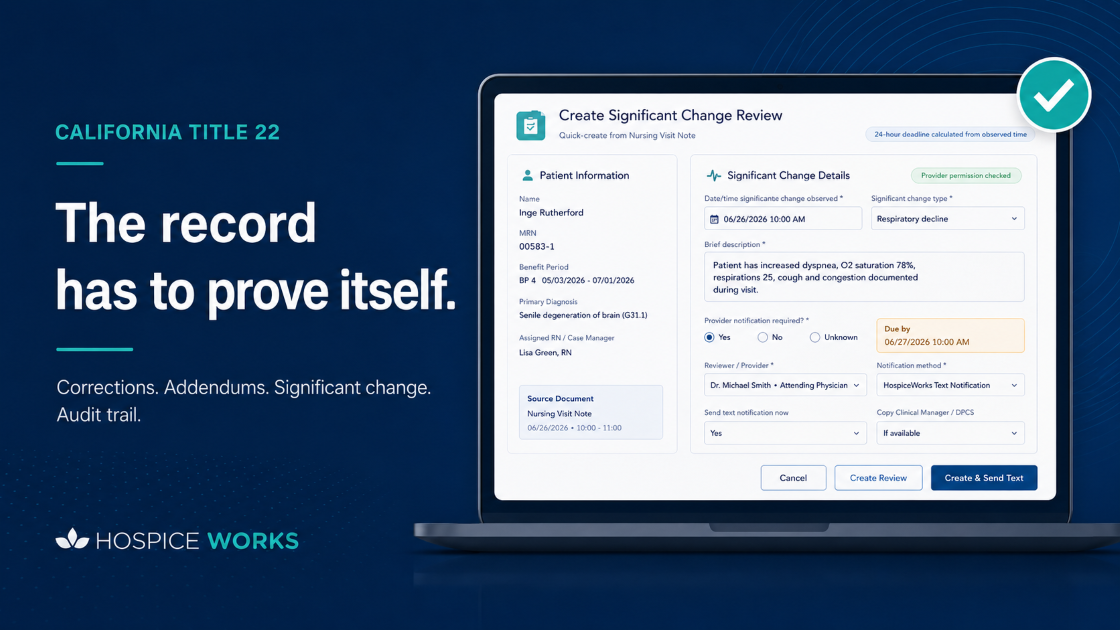
Significant Change Workflow
HospiceWorks is adding structured significant change workflows to help agencies identify, document, and track significant changes that may require physician notification and plan-of-care review.
The goal is to move significant change documentation out of buried narrative text and into a visible workflow that supports accountability, follow-up, and survey readiness.
The workflow is designed to help track:
- the significant change trigger,
- the date and time of observation,
- required physician notification,
- notification status,
- follow-up documentation,
- and visibility for agency leadership.
48-Hour Addendum and Correction Workflow
HospiceWorks is also releasing structured addendum and correction workflows designed around California’s 48-hour correction requirement after discovery.
These workflows are designed to help agencies manage corrections, late entries, and added documentation with clearer timestamps, authentication, and audit visibility.
The goal is to help the agency answer the questions a surveyor may ask:
- When was the issue discovered?
- When was it corrected?
- Who corrected it?
- Why was it corrected?
- Was the original record preserved?
- Was the addendum distinct and traceable?
- Is the correction history visible in the audit trail?
HospiceWorks is not treating Title 22 as a checklist.
We are treating it as a workflow standard.
Documentation Defense Before Survey
California hospice agencies should not have to depend on spreadsheets, manual QA tracking, or after-the-fact reconstruction when CDPH asks for proof.
The stronger approach is to build the compliance workflow into the EMR itself.
HospiceWorks is designed to help hospice teams chart faster, defend the record, and stay survey-ready.
That means helping agencies see what is pending, what is late, what was corrected, what requires follow-up, and what can be produced during survey.
Title 22 is moving hospice documentation from record storage to record defense.
For California hospices, the question is no longer:
“Can my EMR create a note?”
The better question is:
Can my EMR prove compliance when CDPH asks?
Questions California Hospices Should Ask Their EMR Vendor
Every California hospice should be asking clear questions right now:
- Can the system show clinical notes were written or dictated on the day of service?
- Can the system preserve the original record after signature?
- Can corrections document the date of discovery, date of correction, reason for correction, and authentication?
- Can the system track whether correction of a medical-record error occurred within 48 hours of discovery?
- Are addendums distinct, traceable, dated, and authenticated?
- Can the system identify significant change triggers?
- Can the system track physician notification within 24 hours of observation when required?
- Can leadership see pending, overdue, and completed compliance items across the agency?
- Can the system produce an audit trail showing dates, times, authors, corrections, amendments, addendums, change entries, and late entries?
- Can the agency defend the record without rebuilding the timeline manually?
These questions are not theoretical.
They are now part of the California hospice compliance reality.
See the HospiceWorks Title 22 Release
HospiceWorks is actively releasing California Title 22 workflows for significant change tracking and 48-hour addendum/correction management.
These updates are designed to help California hospices strengthen documentation integrity, reduce manual tracking, and improve survey readiness under the new requirements.
Frequently Asked Questions
What is changing for California hospice documentation under Title 22?
California Title 22 creates more specific expectations around medical-record documentation, same-day clinical notes, significant change notification, corrections, addendums, late entries, and electronic audit trails. Hospices using an EHR must be able to track documentation activity, including dates, times, authors, corrections, amendments, addendums, and change or late entries for an audit trail that may be requested by the Department.
Does Title 22 require medical-record errors to be corrected within 48 hours?
Yes. Title 22 states that authorized hospice personnel must correct medical-record errors, including record duplications or documentation in the wrong patient record, within 48 hours of discovery. The correction must also document the date of discovery, date of correction, reason for correction, and authentication.
Does Title 22 require addendums to be separate and traceable?
Yes. If authorized hospice personnel add information after the time of original entry, they must make an addendum. The addendum must be distinct and traceable and include the date and authentication of the authorized hospice personnel making the added entry.
What is the significant change notification requirement?
If hospice personnel or a hospice volunteer observes a significant change in the patient’s condition that may require a plan-of-care modification, the attending physician, hospice Medical Director, or Medical Director Designee must be notified as soon as possible within 24 hours of observation.
How is HospiceWorks responding?
HospiceWorks is releasing California Title 22 workflows focused on significant change tracking and 48-hour addendum/correction management. These workflows are designed to help agencies document key events, track follow-up, preserve record integrity, and improve audit visibility.
About the Author
Ramon Sanchez | Founder & CEO, HospiceWorks
Ramon Sanchez has been a driving force in senior healthcare since 2004. With more than 22 years of experience as a hospice agency owner, operator, and software innovator, he understands the real-world documentation, compliance, billing, and clinical workflow challenges hospice providers face every day.
Before founding HospiceWorks, Ramon founded Greene Health Care Inc., a hospice solutions company where he worked directly with hospice owners, administrators, clinicians, QA teams, and operational leaders to navigate Medicare compliance, audits, revenue cycle challenges, and documentation risk.
As Founder & CEO of HospiceWorks, Ramon is focused on helping hospice agencies move from reactive chart review to proactive documentation defense. HospiceWorks was built to help agencies chart faster, strengthen eligibility documentation, protect record integrity, and stay survey-ready in an era of increasing state and federal scrutiny.
Connect with Ramon on LinkedIn: https://www.linkedin.com/in/ramon-sanchez-009689165/
Sources
- California Department of Public Health, DPH-18-002E Hospice Agency Emergency Regulations, Title 22 CCR §§ 74800–74908.
- California Department of Public Health, Title 22 CCR § 74868, Plan of Care.
- California Department of Public Health, Title 22 CCR § 74896, Patient Medical Record.
- California Department of Public Health, Title 22 CCR § 74900, Electronic Health Records.
- California Hospice and Palliative Care Association, OAL approval notice for California hospice emergency regulations, effective June 22, 2026.