
California did not ban verbal physician communication. It changed when a proposed modification to an existing hospice plan of care may become active.
Written by Ramon Sanchez, Founder & CEO of HospiceWorks | Published July 20, 2026
Key Takeaway
Under California Title 22 CCR § 74868(g), an interdisciplinary team may propose a modification to a patient’s existing plan of care, but the modification may only be implemented after the attending physician, Medical Director, or Medical Director Designee approves it in writing.
For California hospices, that creates a critical EMR question:
Does the system keep a proposed plan-of-care modification pending until written approval is captured—or does it immediately publish the change as an active clinical instruction?
This is not merely a signature issue.
It is a workflow, system-control, and electronic audit-trail issue.
For decades, hospice care has depended on the ability to respond quickly when a patient’s condition changes.
A nurse identifies worsening pain or another clinical need, contacts the physician, receives direction, documents the communication, and coordinates the patient’s care. In many hospice EMRs, an entered order may immediately update the medication profile, care plan, visit instructions, or other clinical views while the physician’s authentication is collected afterward.
That workflow is familiar for a reason.
At the federal level, the Centers for Medicare & Medicaid Services recognizes physician orders, including verbal orders, as part of the hospice clinical record. CMS survey guidance also recognizes that communication with the attending physician may occur through telephone calls, electronic methods, orders received, or other means consistent with hospice policy and patient needs.
Every hospice must also comply with applicable state law. A state may establish requirements that are more restrictive than the federal baseline.
California has now done so for proposed modifications to an existing hospice plan of care.
Under California Title 22 CCR § 74868(g), the interdisciplinary team may propose a modification to a patient’s plan of care, but that modification may only be implemented after the attending physician, Medical Director, or Medical Director Designee approves it in writing.
The emergency regulations took effect June 22, 2026.
This does not mean California prohibited verbal physician communication. It means verbal direction alone is not sufficient to activate a proposed modification to an existing plan of care when § 74868(g) applies.
The distinction is consequential:
The physician’s eventual signature is not the only event that matters. The sequence of proposal, written approval, and activation matters.
The original article correctly identifies that California changed when a proposed plan-of-care modification may become active, rather than simply adding another signature requirement.
California’s Required Sequence at a Glance
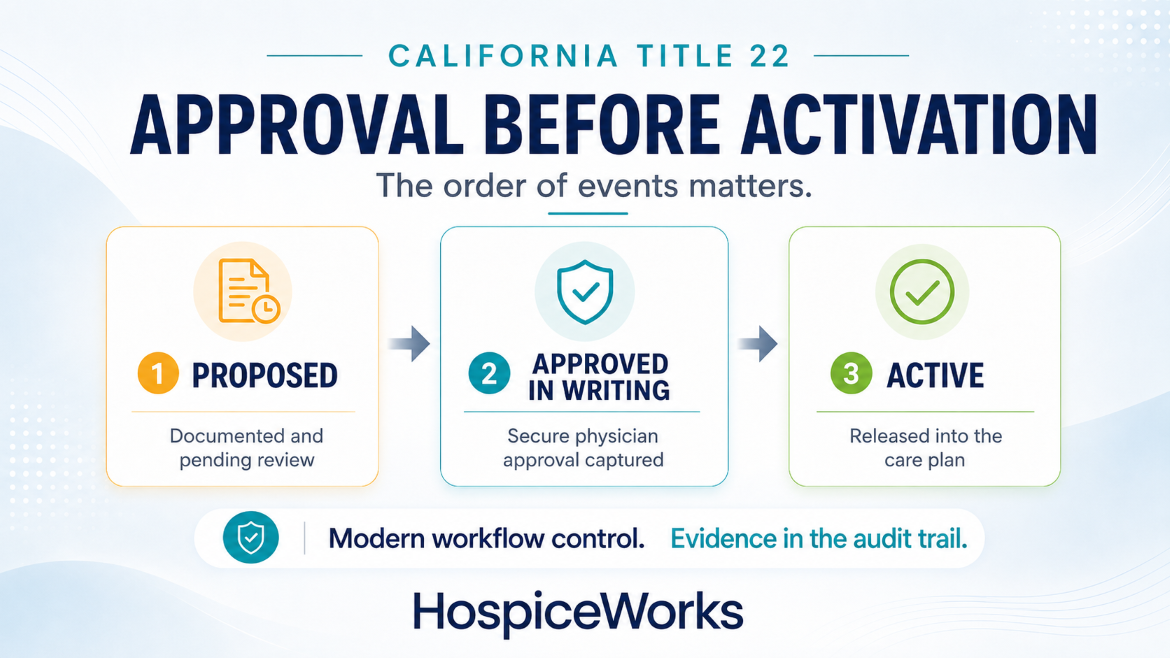
A Title 22-aligned electronic workflow should preserve three separate events:
1. Proposed
The clinician documents the requested medication, treatment, frequency, intervention, equipment, safety, or other plan-of-care change.
The proposed modification may be visible to authorized reviewers, but it should not yet appear to the care team as an approved active instruction.
2. Approved in Writing
The attending physician, Medical Director, or Medical Director Designee reviews the proposed modification and provides written approval.
The electronic record should capture the approver’s identity and the date and time of approval.
3. Active
Only after written approval is captured should the approved modification be released into the applicable plan-of-care, medication, visit, and field-clinician views.
Proposed → Approved in Writing → Active
That sequence is the difference between merely collecting a signature and enforcing the required regulatory process.
The National Workflow California Just Changed
Under the Medicare hospice framework, the interdisciplinary group must maintain an individualized written plan of care and review, revise, and document it as frequently as the patient’s condition requires.
The federal framework recognizes verbal physician orders and multiple methods of physician communication, subject to federal requirements, applicable state law, hospice policy, and accepted standards of practice.
That framework helped shape a common hospice workflow:
Physician direction received → Order entered → Updated instruction becomes available to the care team → Physician authentication collected afterward
California’s licensing regulation establishes a different sequence when the order represents a proposed modification to an existing plan of care:
Modification proposed → Written approval captured → Modification activated → Updated care implemented
The first sequence continues to reflect a commonly accepted workflow under the federal framework and in other states.
The issue is that California has imposed an additional state-specific approval sequence for plan-of-care modifications.
This is a major operational departure from the workflow model around which many hospice organizations and national EMRs were designed.
It does not mean verbal physician communication has no clinical or operational value. It means that when the communication results in a proposed modification to an existing plan of care, California requires written approval before the interdisciplinary team implements that modification.
When an Order Becomes a Plan-of-Care Modification
This distinction matters because the hospice plan of care reaches far beyond visit scheduling.
California’s required plan-of-care content includes the patient’s prescribed method of pain management, orders for treatments and their frequency, symptoms, palliative-care needs, medication assistance, equipment, safety measures, and other individualized clinical instructions.
A proposed change involving a medication dosage, treatment, service frequency, pain-management intervention, equipment, safety measure, or other active clinical instruction may therefore also modify the patient’s plan of care.
The relevant question is not simply:
Did the physician eventually sign the order?
The more important California Title 22 question is:
Was the proposed modification implemented before written approval was captured?
That is where the EMR becomes part of the compliance issue.
What This Article Does—and Does Not—Address
This article addresses proposed modifications to an existing hospice plan of care under § 74868(g).
It should not be interpreted to mean:
- California prohibited every verbal physician order.
- A nurse must delay urgent assessment, physician notification, comfort measures already authorized by the existing plan, or an appropriate emergency response.
- Every admission-stage document or initial physician instruction is governed by the same activation sequence.
- Written approval eliminates the need for clinical judgment, physician communication, hospice policy, or emergency procedures.
During the admission process, verbal physician orders may continue to activate and push into the first Comprehensive Plan of Care. After the Comprehensive Plan of Care is established, subsequent proposed modifications that fall within § 74868(g) require written physician approval before activation.
Hospices should evaluate how § 74868(g) applies to their admission workflows, existing plans of care, standing orders, emergency procedures, and patient-specific circumstances with qualified regulatory or legal counsel.
The Operational Disconnect
Many hospice EMRs were designed to publish an entered order immediately.
A clinician enters a proposed dosage change, and the software may automatically update:
- The active medication profile.
- The plan of care.
- Field-clinician views.
- Visit instructions.
- Medication administration information.
- Follow-up tasks.
The order may still be waiting in a physician signing queue, but the updated instruction is already visible to the care team as though it were active.
That behavior supported the traditional “act now, sign later” workflow.
Under California § 74868(g), it can create a compliance gap.
| California Title 22 requirement | Common EMR behavior |
|---|---|
| A proposed plan-of-care modification may only be implemented after written approval. | The entered modification immediately appears in active clinical views before written approval is captured. |
The clinical team may simply be following the workflow presented by the software.
The electronic record may nevertheless indicate that the modification became active before the required approval occurred.
What the Electronic Audit Trail May Reveal
Consider this hypothetical sequence:
10:15 a.m. — A clinician enters a proposed medication-dosage modification.
10:16 a.m. — The modified dosage becomes visible in the active medication profile and field-clinician views.
10:30 a.m. — The clinical record documents care delivered under the modified dosage.
Five days later — The physician’s written approval is captured.
The concern is not that the clinician failed to document the physician’s direction.
The concern is that the electronic sequence may indicate that the proposed plan-of-care modification was implemented before written approval was obtained.
A delayed signature does not erase the preceding electronic events.
Depending on the system, the audit trail may establish:
- When the proposed modification was drafted.
- When it appeared in active clinical views.
- When staff accessed the modified instruction.
- When related care was documented.
- When written approval was captured.
- When the modification formally became active.
The EMR therefore preserves evidence of the workflow sequence, regardless of whether the hospice intended to implement the change prematurely.
The article’s audit-trail example is central because California’s electronic-record requirements focus on dates, times, authorship, changes, corrections, amendments, addendums, and late entries.
Why a Manual Policy Alone Is Not Enough
A hospice may adopt a policy instructing clinicians:
Do not implement the proposed modification until written physician approval is captured.
That policy is necessary.
But if the EMR immediately publishes the proposed change as an active instruction, the organization’s policy and its clinical technology are contradicting one another.
That creates several risks:
- A field clinician may reasonably believe the displayed instruction is active.
- Different clinicians may apply the manual hold procedure differently.
- Proposed and approved versions may be difficult to distinguish.
- The hospice may be unable to demonstrate precisely when activation occurred.
- Urgent proposed changes may remain buried in a routine signing queue.
- The audit trail may show active publication before approval, even when policy instructed staff not to proceed.
Compliance should not depend on every staff member remembering to disregard what the clinical system displays.
The EMR should maintain separate workflow states:
- Proposed — The modification has been drafted.
- Pending Written Approval — It is available to the authorized reviewer but is not an active clinical instruction.
- Approved — Written approval has been authenticated and timestamped.
- Active — The approved modification has been released into applicable clinical views.
A proposed modification should not be treated as active merely because someone entered it into the electronic record.
The EMR should reinforce the hospice’s policy—not force clinicians to work around it.
The Required Sequence: No Written Approval, No Activation
A Title 22-aligned electronic workflow should operate as follows:
1. The clinician drafts the proposed modification
The clinician documents the requested medication, treatment, frequency, equipment, safety, or intervention change.
2. The system places it in Pending Written Approval
The proposed modification remains visible to authorized reviewers but is not displayed to the care team as an approved active instruction.
3. The physician is alerted immediately
A secure alert informs the attending physician, Medical Director, or Medical Director Designee that an item requires review.
Clinical information should remain protected behind authenticated access rather than being exposed through an ordinary text message.
4. The physician reviews and approves the modification in writing
The physician accesses the proposed change from a smartphone, tablet, or desktop and provides electronic written approval.
5. The system records the approval event
The approval is linked to the proposed modification with the reviewer’s identity, date, and time.
6. The approved modification becomes active
Only after written approval is captured does the system publish the modification to the active plan of care and applicable clinical views.
7. The complete sequence remains available for survey review
The hospice can demonstrate when the modification was proposed, when written approval was captured, and when the approved change became active.
That is the difference between collecting a signature and enforcing the required sequence.
Preserving Patient Responsiveness
A controlled approval process should not mean leaving a patient in distress while an order sits unnoticed.
The answer is not to bypass the written-approval requirement.
The answer is to make physician review fast and accessible.
An effective workflow should provide:
- Immediate secure alerts.
- Mobile-responsive physician access.
- Direct access to the pending modification.
- A clear written-approval action.
- Immediate activation after approval.
- Escalation when approval remains pending.
- A timestamped workflow history.
The physician should not have to download a separate application, navigate through multiple menus, or wait until the next routine batch-signing session.
The faster the physician can review the proposed modification, the faster the care team can respond while maintaining the sequence California requires.
The Question Every California Hospice Should Ask Its EMR Vendor
Do not ask only whether the system can collect physician signatures.
Ask this:
When an order modifies the patient’s existing plan of care, does your EMR keep that proposed change in a pending state until written physician approval is captured—or does it immediately publish the change to active clinical views?
Then ask:
- Can clinicians clearly distinguish a proposed modification from an active order?
- Is the proposed change withheld from active medication and care-plan instructions?
- Can the physician review it directly from a mobile device?
- Does the system record separate proposal, approval, and activation timestamps?
- Does activation occur automatically after written approval?
- Can the hospice produce the complete sequence during a survey?
- What prevents staff from acting on the modification before approval?
If the answer depends on a manual policy, spreadsheet, sticky note, or staff remembering not to follow what the EMR displays, the software is not enforcing the required process.
Operationalizing Title 22 With HospiceWorks
HospiceWorks translates California’s regulatory sequence into a structured electronic workflow.
During the admission process, verbal physician orders may continue to activate and push into the first Comprehensive Plan of Care.
After the Comprehensive Plan of Care is established, when a proposed order modifies the patient’s existing plan of care, the HospiceWorks California workflow maintains the modification in a Pending Written Approval state rather than immediately publishing it as an active instruction.
The proposed modification remains available to authorized reviewers while being withheld from active clinical use.
The appropriate physician can be alerted, authenticate into HospiceWorks from a smartphone, tablet, or desktop, review the pending item, and provide electronic written approval.
After approval is captured, HospiceWorks records the approval event and activates the modification for the care team.
The workflow preserves the sequence California now requires:
Proposed. Reviewed. Approved in writing. Activated.
HospiceWorks also supports structured California workflows for:
- 24-hour significant-change notification and physician review.
- Structured 48-hour documentation-error corrections and addendums.
- Follow-up tracking linked to the clinical record.
- Timestamped workflow history.
- Survey-focused reporting and evidence.
The purpose is not to replace legal counsel, hospice policy, or clinical judgment.
It is to provide technology that supports all three.
The HospiceWorks section appropriately connects the regulation to an electronic control without replacing the article’s educational purpose.
California Changed the EMR Standard
The national Medicare framework recognizes verbal physician orders and flexible methods of physician communication.
California has added a more restrictive requirement for proposed modifications to an existing hospice plan of care: written approval before implementation.
That changes what a California hospice must be able to demonstrate.
It is no longer enough to show that a physician eventually signed the modification.
The hospice must be able to show that:
- The proposed modification remained pending before approval.
- Written approval was captured by an authorized physician.
- Approval occurred before the modification became active.
- The activation event was recorded separately.
- The complete sequence can be produced for survey review.
This is not simply a documentation issue.
It is a workflow, system-control, and electronic audit-trail issue.
And it raises a critical question for every California hospice:
Can Your EMR Prove That Approval Came Before Activation?
Book a 15-Minute Demo with the HospiceWorks team to see how the California Title 22 workflow manages proposed plan-of-care modifications, written approval, activation, and survey evidence.
Frequently Asked Questions
Did California ban verbal physician orders for hospice?
No. California did not prohibit all verbal physician communication.
A physician may still communicate clinical direction verbally. However, when that direction results in a proposed modification to an existing patient plan of care, § 74868(g) requires written approval before the interdisciplinary team implements the modification.
Verbal notification and written approval are therefore separate events.
What changed under California Title 22 § 74868(g)?
The regulation requires written approval before a proposed plan-of-care modification is implemented.
For an electronic record, this means the system should be able to distinguish when the modification was proposed, when written approval was captured, and when the approved modification became active.
When did the new California hospice regulations take effect?
The DPH-18-002E emergency hospice regulations took effect June 22, 2026.
Which orders may be considered plan-of-care modifications?
An order may modify the plan of care when it changes an existing patient-specific instruction involving matters such as:
- Medication dosage or administration.
- Pain or symptom-management interventions.
- Treatments.
- Service type or frequency.
- Medical equipment.
- Safety measures.
- Other individualized clinical instructions included in the plan of care.
The exact application depends on the content of the existing plan, the proposed change, hospice policy, and the patient’s circumstances.
Does this requirement apply to initial admission orders?
This article focuses on modifications to an existing plan of care.
During the admission process, verbal physician orders may continue to activate and push into the first Comprehensive Plan of Care. After the Comprehensive Plan of Care is established, subsequent proposed modifications that fall within § 74868(g) require written physician approval before activation.
Hospices should still evaluate their specific admission and initial-plan workflows against applicable state and federal requirements.
Who may provide the written approval?
Section 74868(g) identifies the patient’s attending physician, hospice Medical Director, or Medical Director Designee.
Does electronic approval satisfy the written-approval requirement?
Title 22 permits electronic authentication in place of a physical signature when the hospice maintains the required authentication policies and unique user identifiers.
The central issue remains sequence: approval must be captured before the proposed modification is implemented.
What should the EMR do while approval is pending?
The proposed modification should remain clearly identified as pending.
It should be accessible to authorized reviewers without being presented to the care team as an approved active instruction.
After written approval is captured, the system should record the approval event and release the approved modification into the appropriate clinical views.
Can a hospice rely on a manual policy telling staff not to act?
A policy is important, but a manual policy alone may not resolve the risk if the EMR already displays the proposed modification as active.
The stronger system design is to withhold the proposed modification from active clinical use until written approval is captured.
What should a California hospice ask its EMR vendor?
Ask:
When an order modifies the patient’s existing plan of care, does your system keep the proposed change pending until written approval is captured, or does it immediately publish the change into active clinical views?
Then ask whether the system records separate proposal, approval, and activation timestamps and whether the complete sequence can be produced during a survey.
Does written approval mean a patient must wait for urgent care?
No. A controlled approval process should not mean leaving a patient in distress or delaying an appropriate emergency response.
The operational answer is to make physician review fast and accessible through secure alerts, mobile-responsive access, escalation, and immediate activation after approval.
Hospices must also follow their emergency procedures, existing orders, clinical policies, and applicable laws.
Sources
California Code of Regulations, Title 22, Division 5, Chapter 6.5 — Hospice Agencies
- § 74868(c) — Required plan-of-care content.
- § 74868(g) — Written approval before implementing proposed plan-of-care modifications.
- § 74900(a)(2) — Electronic health-record audit-trail requirements.
- § 74900(a)(4) — Electronic authentication requirements.
42 C.F.R. Part 418 — Medicare Hospice Conditions of Participation
- § 418.56 — Interdisciplinary group, care planning, and coordination of services.
- § 418.104 — Clinical records.
CMS State Operations Manual, Publication 100-07, Appendix M — Guidance to Surveyors: Hospice
- Interpretive Guidelines § 418.56(d) — Physician communication methods.
- Clinical-record guidance § 418.104 — Physician orders, including verbal orders.
This article is provided for informational purposes and is not legal advice. Hospice agencies should consult qualified legal or regulatory counsel regarding compliance with California Title 22 and federal hospice requirements.
About the Author
Ramon Sanchez | Founder & CEO, HospiceWorks
Ramon Sanchez has worked in senior healthcare since 2004 and has more than 22 years of experience as a hospice agency owner, operator, and software innovator.
Before founding HospiceWorks, Ramon founded Greene Health Care Inc., where he worked directly with hospice owners, administrators, clinicians, QA teams, and operational leaders on Medicare compliance, medical-record risk, audits, revenue cycle management, and clinical operations.
As Founder and CEO of HospiceWorks, Ramon is focused on helping hospice agencies move from reactive chart cleanup to proactive documentation defense through modern hospice workflows, structured compliance data, and Hospice Audit Guard Co-Pilot™.