
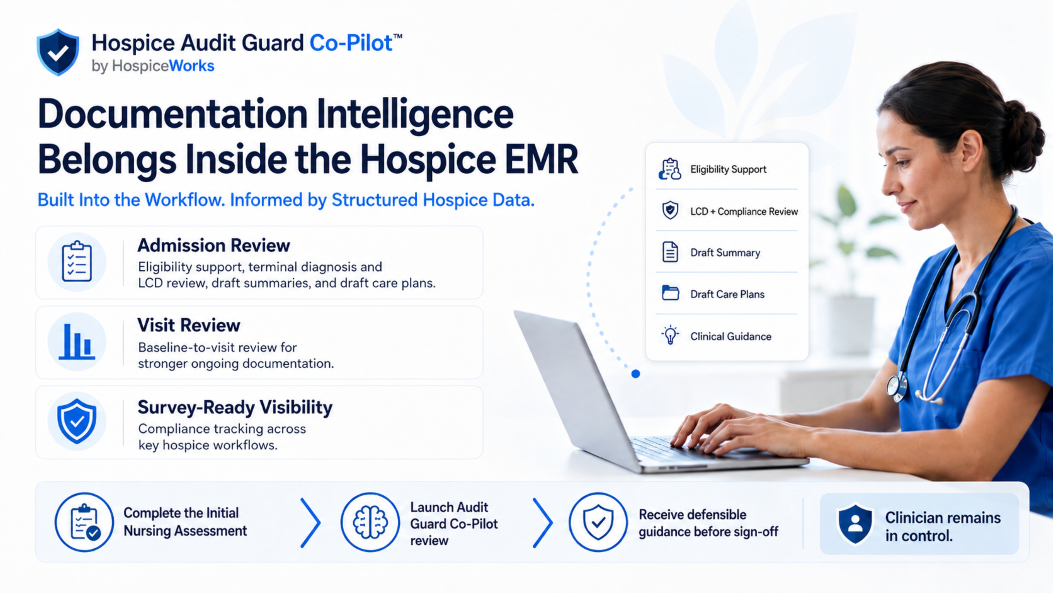
Built into the clinical workflow. Informed by hospice-specific structured data. Available before the clinician signs the record.
Written by Ramon Sanchez, Founder & CEO of HospiceWorks
A hospice documentation tool can produce a polished clinical narrative and still miss the most important risk in the patient’s record.
It may not know:
- What the patient’s condition looked like at admission
- Whether a symptom is new or worsening
- Whether the current findings are consistent with the documented baseline
- Which medications and interventions are already in place
- Whether a PRN intervention was effective
- Whether abnormal findings received appropriate follow-up
- Whether the plan of care reflects the patient’s current needs
- Whether the record clearly supports the patient’s hospice eligibility and clinical trajectory
That is the limitation of treating documentation intelligence as an add-on.
Hospice Audit Guard Co-Pilot™ is different.
It is built directly into the HospiceWorks clinical workflow and uses structured hospice information from the applicable assessment or visit, together with available patient context.
The clinician does not need to leave the chart, copy information into another application, upload a completed note, or wait until after sign-off for the documentation to be reviewed.
Audit Guard evaluates the record where the documentation is being created—while the clinician can still review the findings, strengthen the chart, and make the final clinical decision.
Key Takeaway
Hospice Audit Guard Co-Pilot™ is not a disconnected writing assistant layered onto an EMR. It is a native component of the HospiceWorks hospice EMR.
Because Audit Guard operates inside the clinical workflow, it can use structured hospice information already contained in the patient’s record, including:
- Admission and terminal-diagnosis information
- Prior patient baseline
- Current assessment findings
- Symptoms and symptom severity
- Functional and cognitive status
- Vital signs
- Medications and treatments
- PRN interventions and effectiveness
- Caregiver capability and concerns
- Existing care-plan problems and interventions
- Prior nursing-visit findings
- Documented changes in the patient’s condition
Audit Guard uses this clinical context to help surface potential documentation gaps, compare current findings with prior information, and develop patient-specific recommendations before the clinician signs the record.
The clinician reviews each finding and can accept, decline, or edit any recommendation.
Audit Guard provides the visibility. The clinician remains in control.
A Completed Chart Is Not Always a Defensible Chart
Many hospice EMRs are designed primarily to track whether required documentation has been completed.
They can generally tell the hospice:
- Whether a document was started
- Whether required fields were entered
- Whether the clinician signed the note
- Whether the documentation was completed on time
- Whether a required assessment or visit is missing
Those controls are important.
But document completion alone does not determine whether the clinical record tells a complete, consistent, and defensible story.
- A checked field does not prove that the record clearly supports hospice eligibility.
- A signed nursing note does not prove that a meaningful change from baseline was identified.
- A completed PRN visit does not prove that the intervention and its effectiveness were documented.
- A completed care plan does not prove that it reflects the patient’s current symptoms, risks, and needs.
- A well-written narrative does not prove that it is consistent with the underlying assessment findings.
That is the difference between document completion and documentation defense.
Traditional QA Often Finds the Problem Too Late
In a traditional hospice QA process, the clinician completes the visit and signs the documentation.
The record is then reviewed by a supervisor, quality reviewer, administrator, or compliance team.
That later review may identify:
- Weak hospice-eligibility support
- Incomplete documentation of decline
- Findings that conflict with another part of the record
- New symptoms without documented follow-up
- Abnormal findings that were not addressed
- An intervention without documented effectiveness
- A patient need not reflected in the plan of care
- Medication or treatment questions
- A clinical narrative that does not clearly reflect the structured findings
The chart may then be returned to the clinician.
The clinician must reopen the record, remember what occurred, provide clarification, or complete an addendum after the patient encounter has ended.
The hospice is now working backward.
The traditional process
Visit completed → Record signed → QA review → Concern identified → Chart returned → Documentation clarified
By the time the concern is found:
- The clinician may already be caring for another patient
- Important details may no longer be fresh
- The record may already have moved downstream
- QA staff must spend time returning and tracking the chart
- Additional clarification or correction may be required
The limitation is not necessarily the quality of the reviewer.
The limitation is when the reviewer sees the record.
The HospiceWorks Model: Review Before Sign-Off
Hospice Audit Guard Co-Pilot™ moves documentation review into the active clinical workflow.
The HospiceWorks process
Visit documented → Audit Guard review → Findings surfaced → Clinician accepts, declines, or edits → Record strengthened → Clinician signs
This does not eliminate the need for clinical oversight or quality review.
It gives the clinician earlier visibility into potential concerns while the encounter is still fresh and the record can still be evaluated before sign-off.
Traditional QA asks the team to repair the chart later.
Audit Guard helps the clinician strengthen the record earlier.
Built Into the EMR Is Not the Same as Added Onto the EMR
The term “documentation intelligence” can describe very different products.
Many add-on tools operate separately from the clinical record. They may receive:
- A dictated narrative
- Copied and pasted text
- A completed document
- An uploaded PDF
- A limited set of data sent through an interface
These tools may be useful for transcription, summarization, or writing assistance.
But the information they receive may not include the complete clinical relationships stored throughout the hospice record.
For example, an add-on may see that the nurse documented increased pain.
A native hospice workflow can also evaluate the documented context surrounding that pain:
- The patient’s prior pain level
- Whether the pain is new or worsening
- Current severity and characteristics
- Medications available for pain
- A documented PRN intervention
- The effectiveness of that intervention
- Existing pain-related care-plan interventions
- Prior physician or IDG coordination
- Whether the current findings may require additional follow-up
The difference is not simply where the tool appears on the screen.
The difference is the clinical context available to the review.
An add-on may review the text submitted to it.
Audit Guard reviews the hospice record supporting that documentation.
Why Hospice Structured Data Matters
A hospice patient’s clinical story is not contained in one narrative.
It is distributed across interconnected information throughout the medical record:
- Terminal and related diagnoses
- Eligibility findings
- Admission assessments
- Functional status
- Cognitive status
- Symptom assessments
- Vital signs
- Medication orders
- Treatments and interventions
- Caregiver capability
- Nursing-visit findings
- PRN effectiveness
- Plan-of-care problems and interventions
- IDG review
- Recertification support
When this information is captured in structured fields, HospiceWorks can evaluate relationships across the record.
Audit Guard can help determine whether the documentation may need additional review because:
- A current finding represents a change from baseline
- A symptom appears to have worsened since a prior visit
- An abnormal vital sign may require follow-up
- An intervention was documented without its effectiveness
- A documented patient need may require care-plan consideration
- The structured findings and clinical summary may not be fully consistent
- The record may need stronger support for hospice eligibility
- The patient’s documented decline or trajectory may not be clear
A tool reviewing only a final narrative may not have access to all of these relationships.
That is why Hospice Audit Guard Co-Pilot™ is designed around structured hospice data, not simply generated text.
The Native Workflow Advantage
Documentation review is most valuable when it appears at the right moment.
Because Audit Guard is built into HospiceWorks, the review occurs inside the same workflow where the clinician documents the patient encounter.
The clinician does not have to:
- Open a separate application
- Copy and paste protected health information
- Upload a document for outside review
- Re-enter patient information
- Wait for a completed note to be processed
- Manually compare recommendations against the patient’s chart
- Move between disconnected systems
- Complete a separate administrative review process
Instead, the clinician can:
- Complete the structured clinical documentation.
- Initiate the Audit Guard review.
- Review findings connected to the patient’s documented information.
- Evaluate the supporting evidence.
- Accept, decline, or edit recommendations.
- Complete any appropriate clarification or follow-up.
- Sign the strengthened record.
The review becomes part of the clinical workflow instead of another task added after the visit.
Add-On Documentation Assistance Versus Native Clinical Intelligence
| Capability | Disconnected add-on | Hospice Audit Guard Co-Pilot™ |
|---|---|---|
| Position in workflow | Outside or layered onto the EMR | Built directly into HospiceWorks |
| Review timing | Often after dictation or document completion | Before clinician sign-off |
| Primary data source | May rely on text, uploads, exports, or limited interfaces | Uses hospice-specific structured data already in the record |
| Prior patient context | May be limited to the information submitted | Can evaluate current findings against documented baseline and prior visit information |
| Hospice-specific relationships | May require manual interpretation | Designed around hospice assessments, symptoms, medications, interventions, eligibility, and care planning |
| Care-plan context | May not have access to active problems and interventions | Can develop patient-specific care-plan recommendations from documented needs |
| Workflow impact | May require duplicate entry or context switching | Review occurs within the clinical documentation process |
| Recommendation control | Depends on the product | Clinician can accept, decline, or edit |
| Final clinical decision | Must remain with the clinician | Remains with the clinician |
Not every add-on works the same way. The central question is whether the tool has native access to the structured hospice record and is positioned inside the clinician’s workflow before sign-off.
How Hospice Audit Guard Co-Pilot™ Works
1. The clinician documents the encounter
The clinician completes the structured Initial Nursing Assessment or Nursing Visit Note in HospiceWorks.
The record may include:
- Symptoms
- Functional status
- Cognitive findings
- Vital signs
- Medications
- Treatments
- Interventions
- Caregiver concerns
- Safety risks
- Clinical changes
- Coordination and follow-up
2. Audit Guard evaluates the documented record
Before signing, the clinician initiates an Audit Guard review.
Audit Guard evaluates the structured information and looks for areas that may require clarification, stronger clinical support, follow-up, or additional consideration.
3. Findings are connected to clinical evidence
Audit Guard presents evidence-based findings tied to information already contained in the patient’s record.
Depending on the encounter, the review may include:
- Missing or incomplete documentation
- Hospice-eligibility support
- Baseline-to-current-visit comparisons
- New or worsening symptoms
- Abnormal findings requiring consideration
- PRN intervention effectiveness
- Medication or treatment concerns
- Patient-specific care-plan recommendations
- A draft clinical summary
4. The clinician reviews every recommendation
The licensed clinician determines whether the finding is clinically appropriate.
Recommendations can be:
- Accepted
- Declined
- Edited
- Used to prompt additional follow-up
Nothing becomes part of the completed medical record merely because Audit Guard suggested it.
5. The clinician signs the final record
After reviewing the findings and making any appropriate updates, the clinician finalizes and signs the documentation.
The record is stronger before it moves to QA, billing, IDG review, survey preparation, an ADR response, or another audit process.
Audit Guard at Admission
The admission record establishes the clinical foundation for the entire hospice episode.
Weaknesses at admission can affect:
- Eligibility support
- The initial plan of care
- IDG review
- Recertification
- Billing
- Survey readiness
- The hospice’s ability to defend the record later
Hospice Audit Guard Co-Pilot™ reviews the Initial Nursing Assessment before sign-off.
The review can help surface:
- Missing or incomplete eligibility support
- Clinical findings that may require greater detail
- Consistency between the terminal diagnosis and documented conditions
- Functional and cognitive findings
- Symptom burden
- Medication and treatment information
- Caregiver capability and concerns
- Psychosocial, spiritual, safety, and support needs
- Patient-specific care-plan considerations
- A draft admission clinical summary
Because Audit Guard is native to HospiceWorks, it can evaluate structured information from the admission workflow rather than relying only on the final narrative.
The clinician receives the findings while the assessment is still fresh and before the admission documentation becomes the foundation for the rest of the record.
Audit Guard During Ongoing Nursing Visits
A nursing note should show more than what happened during one isolated encounter.
It should help demonstrate the patient’s clinical story over time.
Hospice Audit Guard Co-Pilot™ can compare current structured findings with previously documented patient information.
This baseline-to-visit review can help surface:
- New or worsening symptoms
- Changes in mobility or functional status
- Changes in cognition
- Declining intake
- Increased caregiver needs
- Changes in symptom severity
- New abnormal findings
- Interventions requiring effectiveness documentation
- Medication or treatment concerns
- Potential care-plan updates
- A draft visit summary based on the documented findings
The clinician can then determine whether the record needs:
- Additional clarification
- Clinical follow-up
- Coordination of care
- An updated intervention
- Care-plan consideration
- Another appropriate action
Audit Guard does not determine the patient’s care.
It helps the clinician see the documented relationships that may require attention.
A Writing Tool and a Hospice Clinical Review Serve Different Purposes
A general writing tool can help make a paragraph clearer.
That may be useful, but clearer writing does not automatically create stronger clinical documentation.
A note can sound polished while still failing to demonstrate:
- Why the patient remains eligible for hospice
- How the patient has changed over time
- Whether symptoms are improving or worsening
- Whether an intervention was effective
- Whether abnormal findings were addressed
- Whether the plan of care reflects current needs
- Whether the narrative is consistent with the structured assessment
Hospice Audit Guard Co-Pilot™ is designed to examine the underlying hospice documentation—not merely rewrite the clinician’s words.
Its purpose is to help identify what the record may be missing, not simply make the record sound better.
This Is Not Automated Documentation
Technology should support clinical judgment, not replace it.
Hospice Audit Guard Co-Pilot™ does not independently:
- Diagnose the patient
- Determine hospice eligibility
- Change an assessment
- Add unsupported clinical findings
- Activate a medication or treatment order
- Modify the plan of care
- Finalize the clinical record
- Sign documentation
Audit Guard provides:
- Structured findings
- Supporting evidence
- Areas requiring consideration
- Draft recommendations
- Patient-specific care-plan guidance
- Draft clinical summaries
The clinician reviews the information and makes the final decision.
The goal is not unattended documentation.
The goal is Clinical Intelligence that helps a licensed professional build a stronger record.
“It feels like having an on-demand QA monitor.”
What Audit Guard Helps Surface
| Documentation area | Potential concern | Audit Guard support |
|---|---|---|
| Hospice eligibility | The record may not clearly support the terminal prognosis | Surfaces areas that may require stronger clinical support |
| Patient trajectory | Current findings may not be compared with prior status | Evaluates current documentation against the documented baseline |
| Symptoms | New or worsening symptoms may be difficult to identify across separate notes | Highlights documented changes for clinician review |
| Abnormal findings | A finding may appear without clear follow-up | Identifies areas that may require clarification or action |
| PRN visits | The intervention may be documented without clear effectiveness | Surfaces missing or incomplete effectiveness documentation |
| Medications and treatments | Current findings may raise questions requiring review | Presents documented concerns for clinician consideration |
| Care planning | Patient needs may not be reflected in the plan of care | Develops patient-specific draft recommendations |
| Clinical summary | Structured findings may not form a clear narrative | Creates a draft summary for clinician review and editing |
| QA workflow | Concerns may be discovered after the record is signed | Moves visibility earlier in the documentation process |
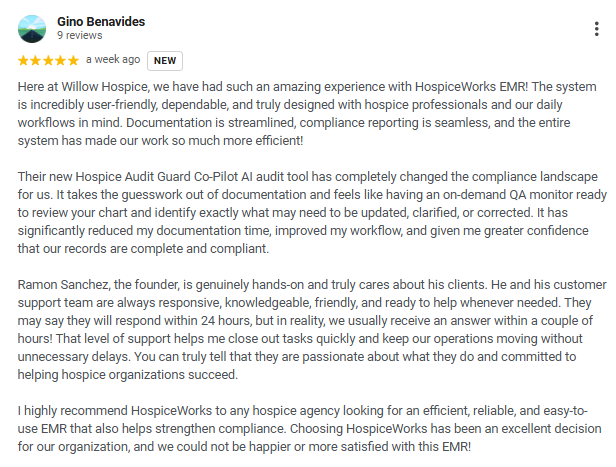
“It Takes the Guesswork Out of Documentation”
“It takes the guesswork out of documentation and feels like having an on-demand QA monitor ready to review your chart.”
Gino Benavides
Owner, Willow Hospice
★★★★★ Google Review
Gino described the effect Audit Guard has had on his documentation process:
“It has significantly reduced my documentation time, improved my workflow, and given me greater confidence that our records are complete and compliant.”
He also highlighted the broader HospiceWorks experience:
“The system is incredibly user-friendly, dependable, and truly designed with hospice professionals and our daily workflows in mind.”
His experience demonstrates why Audit Guard is not simply another report for management to review later.
It gives the person completing the documentation earlier visibility into what may require attention.
That turns documentation review from a delayed correction process into an active part of the clinical workflow.
Individual experiences and results may vary.
The Difference Is Timing, Context, and Architecture
Hospice quality teams have always worked to identify documentation weaknesses.
Audit Guard strengthens that process in three important ways.
Timing
The review occurs before the clinician signs the record, while the encounter is still fresh.
Context
Audit Guard uses structured hospice information from across the patient’s record—not only a submitted paragraph or completed document.
Architecture
Audit Guard is built directly into the HospiceWorks clinical workflow rather than operating as a disconnected application.
Together, these differences allow the review to be more patient-specific, more relevant to the hospice encounter, and easier for the clinician to use.
Finding a concern three days after a visit is different from surfacing it while the clinician is still completing the note.
Finding weak eligibility support after billing is different from identifying it during the admission review.
Finding missing intervention effectiveness after a record request is different from presenting it before sign-off.
The earlier the hospice sees the concern, the more effectively the team can evaluate and address it.
More Than Faster Charting
Faster documentation is valuable.
But speed alone does not create a defensible record.
A clinician can finish a weak note quickly.
A hospice can complete every required document on time and still struggle to demonstrate:
- Why the patient remained eligible
- How the patient changed over time
- Whether symptoms were addressed
- Whether interventions were effective
- Whether the plan of care reflected current needs
- Whether clinical findings were consistent throughout the record
HospiceWorks combines modern, mobile-friendly charting with proactive documentation review.
The objective is to help hospice teams:
- Chart faster.
- Surface risk earlier.
- Strengthen the record.
- Stay survey-ready.
Questions to Ask About Your Current Hospice EMR
Do not ask only whether your EMR includes required hospice forms.
Ask:
- Does it review documentation before the clinician signs?
- Is the review built directly into the clinical workflow?
- Does it use structured hospice data from the patient’s record?
- Can it compare current findings with the patient’s documented baseline?
- Does it surface potential hospice-eligibility support gaps?
- Can it identify new or worsening documented symptoms?
- Does it highlight abnormal findings that may require follow-up?
- Can it evaluate PRN intervention effectiveness?
- Does it develop patient-specific care-plan recommendations?
- Does it provide a draft clinical summary based on documented findings?
- Can the clinician review the evidence supporting each finding?
- Can the clinician accept, decline, or edit recommendations?
- Does the clinician remain in control of every final decision?
- Does the process reduce avoidable documentation being returned by QA?
A form library stores documentation.
A modern hospice EMR should help the clinical team strengthen it.
Documentation Defense Before Sign-Off
Hospice documentation should not become a cleanup project after every visit.
Hospice Audit Guard Co-Pilot™ helps clinicians identify potential gaps, evaluate patient-specific recommendations, and strengthen admission and nursing-visit documentation before sign-off.
Because Audit Guard is built directly into HospiceWorks, it can evaluate structured hospice information from the applicable assessment or visit, together with available patient context.
There is no separate application.
There is no disconnected upload-and-review process.
There is no need to treat documentation intelligence as an afterthought.
The review happens inside the workflow.
The clinician remains in control.
The hospice gains earlier visibility.
And the record is stronger before it becomes a billing, survey, ADR, or audit concern.
See What Audit Guard Can Surface Before the Record Is Signed
Frequently Asked Questions
What is Hospice Audit Guard Co-Pilot™?
Hospice Audit Guard Co-Pilot™ is a Clinical Intelligence documentation-review capability built directly into the HospiceWorks EMR. It evaluates structured admission and nursing-visit information before sign-off and presents findings, clinical guidance, draft summaries, and patient-specific recommendations for clinician review.
Why is a built-in review better than a separate add-on?
A built-in review operates within the clinical workflow and can use structured hospice information from the applicable assessment or visit, together with available patient context. A separate tool may be limited to the text, document, or data submitted to it. Native access gives Audit Guard greater clinical context and eliminates unnecessary context switching or duplicate data entry.
What does structured hospice data mean?
Structured hospice data includes information entered into defined clinical fields, such as symptoms, severity, functional status, cognition, vital signs, medications, interventions, caregiver concerns, baseline findings, care-plan needs, and prior visit information. These data points can be evaluated together to identify relationships that may not be visible in one narrative.
Does Audit Guard automatically change the medical record?
No. Audit Guard does not independently alter or finalize patient documentation. The clinician reviews every recommendation and can accept, decline, or edit it before signing the record.
Does Audit Guard replace hospice QA staff?
No. Audit Guard supports clinicians and QA teams by helping surface potential concerns earlier. It does not replace clinical oversight, compliance leadership, quality review, or professional judgment.
What documentation can Audit Guard review?
Audit Guard is used within the Initial Nursing Assessment and Nursing Visit Note workflows. Reviews can support admission documentation, ongoing patient assessments, baseline comparison, symptom and follow-up review, PRN effectiveness, care-plan recommendations, and draft clinical summaries.
Can Audit Guard determine hospice eligibility?
No software should independently make the final hospice-eligibility decision. Audit Guard can help surface documentation supporting eligibility or identify areas that may require clarification. Physicians and hospice clinicians remain responsible for all eligibility determinations.
How is Audit Guard different from ordinary QA?
Traditional QA often occurs after documentation has been completed or signed. Audit Guard is built into the clinical workflow so potential concerns can be presented while the clinician is still completing the record.
Is Audit Guard a documentation-writing tool?
Audit Guard can develop a draft clinical summary, but it is not simply a writing assistant. It evaluates structured hospice findings, prior patient information, symptoms, interventions, effectiveness, eligibility support, and care-plan considerations. The clinician must review and edit all draft content.
Does Audit Guard use generic recommendations?
Audit Guard develops findings and draft recommendations from the patient’s structured clinical information. The clinician must evaluate whether each recommendation accurately reflects the patient and the care provided.
Is Audit Guard available separately from HospiceWorks?
Audit Guard is built into the HospiceWorks hospice EMR workflow. A HospiceWorks demonstration can show how the review functions within admission and nursing-visit documentation.
About the Author
Ramon Sanchez | Founder & CEO, HospiceWorks
Ramon Sanchez has worked in senior healthcare since 2004 and has more than 22 years of experience as a hospice agency owner, operator, and software innovator.
Before founding HospiceWorks, Ramon founded Greene Health Care Inc., where he worked directly with hospice owners, administrators, clinicians, QA teams, and operational leaders on Medicare compliance, medical-record risk, audits, revenue-cycle management, and clinical operations.
As the architect of Hospice Audit Guard Co-Pilot™, Ramon is focused on helping hospice agencies move from reactive chart cleanup to proactive documentation defense through modern clinical workflows, structured hospice data, and earlier visibility into documentation risk.