
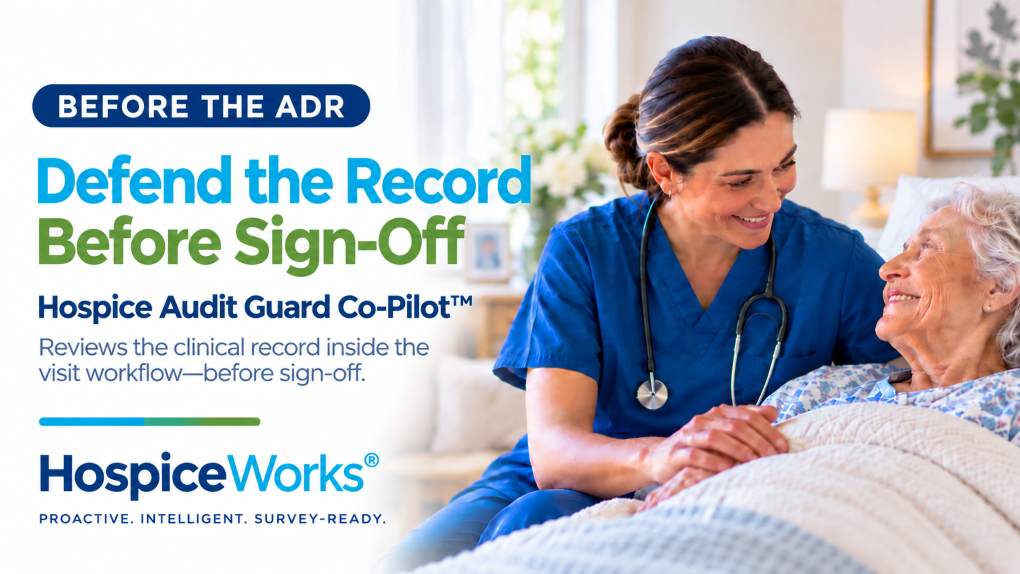
Hospice Audit Guard Co-Pilot™ reviews the clinical record inside the visit screen, before the clinician signs.
What is real-time documentation review inside a hospice EMR?
Real-time documentation review is a pre-signature check that runs inside the clinical visit workflow using the patient’s structured chart data. Hospice Audit Guard Co-Pilot™ surfaces documentation gaps, baseline inconsistencies, missing follow-up, and care plan omissions while the encounter is still fresh and before the clinician signs.
It does not replace clinical judgment. It does not overrule the clinician. It gives the nurse an opportunity to strengthen the record at the moment it is being written.
Why does hospice documentation rework happen after the visit?
Additional Documentation Requests (ADRs), Targeted Probe and Educate (TPE) reviews, and other Medicare medical reviews place significant pressure on hospice agencies.
When documentation is questioned, clinical leadership may spend hours reconstructing the record, reviewing prior visits, locating supporting evidence, and returning notes to clinicians for clarification.
The problem is often timing.
Traditional chart review frequently happens after the note is signed:
- Chasing nurses for missing PRN medication follow-up
- Identifying baseline inconsistencies days after a visit
- Finding symptoms that were documented without a clear intervention
- Returning incomplete records for clarification or addendums
- Reconciling care plans after the encounter has already ended
Technology should never replace clinical judgment, supervisory oversight, or compliance expertise.
But it can provide an earlier defensive layer—while the clinician is still inside the record and the encounter is still fresh.
What causes “chart ping-pong” in hospice documentation?
The traditional documentation workflow often looks like this:
Visit Completed → Note Signed → Reviewer Finds Gap → Chart Returned → Nurse Reopens Record → Clarification or Addendum
The problem is not the reviewer.
The problem is when the review happens.
By the time someone finds the issue, the clinician may have seen several other patients. Clinical details are less immediate. Documentation workflows are interrupted. Billing may be waiting.
A record strengthened while the clinician still has direct knowledge of the encounter is fundamentally different from trying to reconstruct missing context days later.
HospiceWorks moves that first structural review forward:
Visit Documented → Hospice Audit Guard Co-Pilot™ Review → Clinician Refines Record → Defensible Record Signed
See Pre-Signature Documentation Review in Action
Stop spending clinical hours repeatedly sending charts back for preventable documentation gaps.
Schedule a 15-Minute HospiceWorks Demo
See Hospice Audit Guard Co-Pilot™ review a mock admission and routine nursing visit before sign-off.
Built-In Hospice Intelligence vs. Bolted-On AI: What Can Each Actually See?
AI is rapidly entering healthcare software.
But adding AI to a clinical record is not the same as building intelligence into the workflow where that record is created.
Many external AI tools operate primarily on the text they are given—a dictated narrative, uploaded document, transcription, or copied clinical note.
Hospice Audit Guard Co-Pilot™ operates inside HospiceWorks.
That gives it access to the structured hospice context surrounding the visit: assessments, baselines, symptoms, vitals, medications, care plans, and prior clinical information available within the workflow.
| Documentation Capability | Bolted-On AI / External Tools | Built-In Hospice Audit Guard Co-Pilot™ |
|---|---|---|
| Workflow Integration | Separate workflow, screen, transcription, or uploaded content | Native to the HospiceWorks clinical visit workflow |
| Clinical Context | Dependent on the information provided to the external tool | Uses relevant structured HospiceWorks clinical data |
| Review Timing | Often after dictation, transcription, or documentation | Point-of-care, before the clinician signs |
| Baseline Comparison | Limited by the historical data made available to the tool | Can compare current findings with relevant prior structured clinical information |
| Care Plan Alignment | Limited by the care plan context provided | Cross-references identified clinical needs with care plan information |
| Clinical Governance | Depends on the external tool and workflow | Clinician retains authority to accept, edit, or decline |
The difference isn’t simply the AI model.
It’s where the intelligence operates and what clinical context it can use.
“I haven’t found another hospice EMR running this kind of structured, pre-signature review natively inside the visit workflow. If yours does, I’d genuinely like to see it.”
— Ramon Sanchez, Founder & CEO, HospiceWorks
Related reading: Hospice Audit Guard Co-Pilot™: Why Documentation Intelligence Belongs Inside the Hospice EMR
How does pre-signature review strengthen hospice admission documentation?
The admission record establishes the clinical foundation for the hospice episode.
If important eligibility support, functional findings, symptom burden, caregiver concerns, or care plan needs are not clearly documented at admission, the agency may be forced to reconstruct that story later.
Hospice Audit Guard Co-Pilot™ supports the admitting clinician before the assessment is signed by reviewing areas such as:
- Eligibility support. Reviews whether documented functional findings, disease-specific indicators, and other clinical information support the patient’s documented hospice picture.
- Functional scoring and clinical context. Evaluates documented measures such as Functional Assessment Staging Tool (FAST) and Palliative Performance Scale (PPS) findings alongside applicable clinical information.
- Internal consistency. Surfaces potential conflicts between structured assessment findings and narrative documentation.
- Care plan alignment. Prompts the clinician when identified symptoms, caregiver concerns, risks, or other clinical needs may require corresponding care plan attention.
- Missing documentation. Highlights potentially incomplete areas before the assessment is finalized.
Because an initial nursing assessment does not yet have prior hospice visits to compare against, the review focuses heavily on completeness, internal consistency, clinical support, and care plan alignment.
How do hospices document terminal decline for Medicare review?
Demonstrating the patient’s terminal clinical picture over time can become a significant documentation challenge during Medicare medical review—particularly for patients with extended hospice stays.
The evidence may exist across weeks or months of nursing documentation:
A lower PPS score.
Increasing assistance with activities of daily living.
More frequent PRN medication use.
Progressive weakness.
Reduced intake.
Worsening dyspnea.
Increased confusion.
New wounds.
More frequent symptom intervention.
No single finding necessarily tells the entire story.
The clinical record needs to show the picture over time.
During routine nursing visits, Hospice Audit Guard Co-Pilot™ can evaluate current structured information against relevant historical chart data and surface items such as:
- Baseline changes. Highlights differences between current findings and relevant previous clinical information.
- PRN medication follow-up. Identifies documented PRN medication use that may require corresponding effectiveness or symptom follow-up.
- Unaddressed symptoms. Surfaces abnormal findings or worsening symptoms that may lack corresponding clinical documentation or intervention.
- Care plan alignment. Identifies clinical changes that may warrant review of the active plan of care.
- Documentation inconsistencies. Surfaces areas where current structured findings and narrative documentation may not align.
The clinician reviews the prompts while the encounter is still fresh and retains control over the final clinical documentation.
Does Hospice Audit Guard Co-Pilot™ replace clinical oversight?
No.
Hospice Audit Guard Co-Pilot™ is designed to support—not replace—the clinician.
Nothing should substitute for accurate assessment, professional judgment, supervisory review, IDG oversight, or qualified compliance expertise.
The clinician remains responsible for the record.
Hospice Audit Guard Co-Pilot™ provides an earlier opportunity to identify documentation gaps before that record moves downstream.
That changes the condition of the chart when it reaches clinical leadership.
Instead of using valuable clinical time primarily to locate preventable omissions, organizations can focus more attention on higher-level clinical review, patient care, compliance oversight, and audit defense.
The goal is simple:
Defend the record before sign-off.
Frequently Asked Questions
What is an ADR in hospice billing?
An Additional Documentation Request (ADR) is a request for medical-record documentation supporting a Medicare claim.
For a hospice agency, responding effectively means producing a clinical record that clearly supports the services billed, applicable Medicare requirements, and the patient’s hospice eligibility.
The best time to strengthen that record is not when the ADR arrives.
It is when the documentation is being created.
What is a TPE review?
Targeted Probe and Educate (TPE) is a Medicare medical-review process administered through Medicare Administrative Contractors.
When hospice claims are selected for review, documentation quality becomes critical because the medical record must support the services billed and applicable Medicare coverage requirements.
Hospice Audit Guard Co-Pilot™ does not determine whether a provider will be selected for review.
It helps strengthen the clinical documentation that may later be examined.
Can hospice software guarantee that an agency will pass an audit?
No.
No software can guarantee regulatory compliance, Medicare payment, survey outcomes, or the result of a medical review.
Compliance depends on the care actually delivered, accurate clinical assessment, proper documentation, physician involvement, interdisciplinary care, and adherence to applicable requirements.
What software can do is help clinicians identify missing follow-up, inconsistencies, gaps, and other documentation concerns earlier.
Does real-time documentation review slow clinicians down?
It is designed to do the opposite.
Hospice Audit Guard Co-Pilot™ operates inside the HospiceWorks visit workflow instead of requiring the clinician to leave the record, copy information into another application, or wait for a separate post-visit review.
During client training sessions, agencies have estimated approximately an hour saved on initial nursing assessment documentation and roughly 20–30 minutes per routine nursing visit compared with their previous workflows.
Individual results vary by agency, workflow, clinician, and patient complexity.
Who controls what goes into the clinical record?
The clinician.
Hospice Audit Guard Co-Pilot™ can surface prompts and draft clinical language based on information available within the patient’s structured HospiceWorks record.
The clinician determines what is clinically accurate and appropriate and retains authority to accept, edit, or decline recommendations.
What should I expect during a HospiceWorks software demo?
A 15-minute live demonstration uses mock clinical scenarios to show the HospiceWorks admission and routine nursing visit workflows.
You will see how Hospice Audit Guard Co-Pilot™ can surface:
- Documentation gaps
- Baseline inconsistencies
- Clinical follow-up opportunities
- Care plan considerations
- Structured clinical context
—all before the clinician signs the record.
Don’t Wait for the ADR to Find the Documentation Gap
The medical record should be defensible before anyone asks for it.
Hospice Audit Guard Co-Pilot™ brings documentation intelligence directly into the HospiceWorks clinical workflow—where the nurse is charting, where the patient context exists, and while the encounter is still fresh.
Defend the record. Chart faster. Stay survey-ready.
Schedule a 15-Minute HospiceWorks Demo
See Hospice Audit Guard Co-Pilot™ in action during mock admission and routine nursing visit workflows.
About the Author
Ramon Sanchez | Founder & CEO, HospiceWorks
Ramon Sanchez has worked in senior healthcare since 2004 and has more than 22 years of experience as a hospice agency owner, operator, and software innovator.
Before founding HospiceWorks, Ramon founded Greene Health Care Inc., where he worked directly with hospice owners, administrators, clinicians, and operational leaders on Medicare compliance, medical-record risk, audits, revenue-cycle management, and clinical operations.
As the architect of Hospice Audit Guard Co-Pilot™, Ramon is focused on helping hospice agencies move from reactive chart cleanup toward proactive documentation defense through modern clinical workflows, structured hospice data, and earlier visibility into documentation risk.