
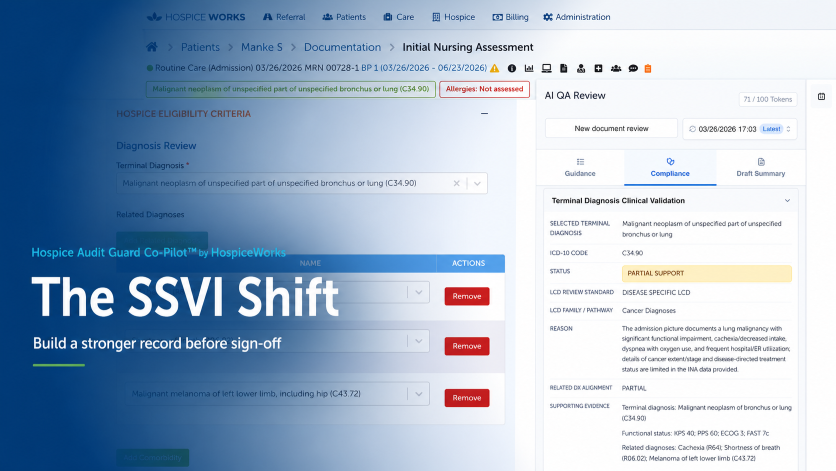
How hospice leaders can respond to rising documentation scrutiny with earlier visibility, stronger workflows, and more defensible records.
The 2026 regulatory environment is putting hospice documentation under a brighter spotlight.
In the FY 2027 hospice proposed rule released on April 2, 2026, CMS introduced the Service and Spending Variation Index, or SSVI, as a new scoring approach based on nine claims-based measures designed to support increased transparency and oversight. CMS has also continued the transition to HOPE, which took effect on October 1, 2025 and moved hospice further toward patient-level, timepoint-based assessment.
For hospice leaders, the takeaway is simple:
Documentation is no longer just a clinical record.
It is part of how your agency demonstrates consistency, appropriateness, and defensibility.
The problem is that most audit tools still work after the fact.
They sit outside the workflow.
They require teams to export data.
They help identify issues only after documentation is already completed, signed, or sent downstream.
At HospiceWorks, we built Hospice Audit Guard Co-Pilot™ differently.
We did not build it to help teams react later.
We built it to help teams catch risk earlier.
What Is the Hospice SSVI?
The Service and Spending Variation Index, or SSVI, is a new CMS scoring approach introduced in the FY 2027 hospice proposed rule.
It is based on nine claims-based measures related to hospice utilization and non-hospice spending. For hospice providers, it reflects growing regulatory focus on transparency, oversight, and documentation defensibility.
That does not mean CMS is directly scoring narrative quality.
It does mean hospices face growing pressure to make sure their records are timely, clinically consistent, and easier to defend.
Why Documentation Matters More in 2026
CMS says the SSVI is designed to identify providers for greater transparency and oversight using nine claims-based measures related to hospice utilization and non-hospice spending.
CMS also says HOPE is intended to support care planning, quality measurement, and quality improvement, and includes required update visits in the first 30 days of the hospice stay depending on length of stay.
Taken together, these changes reinforce a larger shift in hospice:
Documentation must do more than complete the record.
It must support the record.
That is why stronger documentation before sign-off matters more in 2026.
If issues are discovered only after the note is complete, teams lose time, QA gets buried, and the chart becomes harder to defend.
How Can Hospices Prepare for Greater Documentation Scrutiny?
Hospices can prepare by focusing on earlier visibility, stronger workflow support, and better documentation consistency at the point of care.
That means reducing reliance on after-the-fact cleanup and improving the way the chart is built from the start.
The strongest hospice record is not the one that gets fixed later.
It is the one that is stronger before it becomes a QA project, a billing issue, or a survey concern.
This is where Hospice Audit Guard Co-Pilot™ fits.
Hospice Audit Guard Co-Pilot™ is built directly into the HospiceWorks workflow to help teams strengthen documentation before sign-off by supporting:
stronger admission documentation
more clinically grounded ongoing visit documentation
patient-specific draft care plans
draft summaries based on documented findings
earlier visibility into documentation issues before they become cleanup work
From Admission to Ongoing Visits
Hospice Audit Guard Co-Pilot™ is designed to support teams across the hospice workflow, not just at the end of it.
At admission, it helps clinicians identify documentation gaps earlier, support stronger eligibility documentation, and build more complete records before sign-off.
During ongoing visits, it helps teams compare current findings to the patient’s prior documented baseline, strengthen draft documentation summaries, and support patient-specific care plan updates while the chart is still being built.
That matters because the real risk is not only incomplete documentation.
It is delayed visibility.
When teams find problems too late, they spend more time cleaning up the chart and less time strengthening it while the visit is still fresh.
Not Just Faster Documentation. Stronger Documentation.
Many platforms promise faster charting.
But faster documentation is not enough if the record is still weak, generic, or inconsistent.
HospiceWorks is built to help hospices move faster while also building more clinically intelligent, more defensible documentation.
That is the difference.
Hospice Audit Guard Co-Pilot™ is designed to help clinicians and leaders move beyond after-the-fact cleanup and toward proactive documentation defense built into the workflow itself.
If your team is still discovering risk after the note is written, your current system may be helping you chart — but not helping you defend the chart.
See Hospice Audit Guard Co-Pilot™ in action.
Book a 15-minute demo to see how HospiceWorks supports stronger admissions and ongoing visit documentation before sign-off.
Frequently Asked Questions: Hospice Audit Guard Co-Pilot™ by HospiceWorks
What is changing in hospice oversight in 2026?
In the FY 2027 hospice proposed rule released on April 2, 2026, CMS introduced the Service and Spending Variation Index, or SSVI, as a scoring approach based on nine claims-based measures related to hospice utilization and non-hospice spending. CMS has also continued the transition to HOPE, which took effect on October 1, 2025 and added required update visits in the first 30 days depending on patient length of stay.
Does SSVI mean CMS is directly scoring our narratives?
No. SSVI is a claims-based scoring approach, not a direct narrative scoring system. But stronger, more consistent documentation still matters because hospices need records that support the care delivered and are easier to defend under greater oversight.
How is Hospice Audit Guard Co-Pilot™ different from standard QA?
Standard QA often happens after the documentation is already completed. Hospice Audit Guard Co-Pilot™ by HospiceWorks is built into the workflow to help teams catch issues earlier, while the chart is still being built, so records can be stronger before they become a cleanup project.
What does the Co-Pilot help with?
It helps support stronger admission documentation, stronger ongoing visit documentation, draft summaries based on documented findings, patient-specific draft care plans, and earlier visibility into documentation issues before sign-off.
Does the Co-Pilot replace nurse judgment?
No. The clinician remains in control. Hospice Audit Guard Co-Pilot™ is designed to support the team with earlier visibility, structured guidance, and draft support, while the licensed clinician reviews, edits, and approves the final documentation.
How does this relate to HOPE?
HOPE took effect on October 1, 2025 and introduced a more patient-level, timepoint-based assessment structure, including update visits in the first 30 days for qualifying stays. That increases the value of documentation workflows that are timely, structured, and consistent.
What about the election statement addendum requirement?
CMS proposed in the FY 2027 hospice rule that hospices provide the election statement addendum to all Medicare beneficiaries at the time of hospice election. Because this is part of a proposed rule, it is best to describe it as a proposed requirement unless and until finalized.
What is the business value of Hospice Audit Guard Co-Pilot™?
The business value is earlier visibility, less after-the-fact cleanup, stronger workflow support at admission and during ongoing visits, and a more defensible record. If you want to include time-savings or ROI figures, those should be clearly labeled as your internal estimates or modeled results.
About the Author
Ramon Sanchez | Founder & CEO, HospiceWorks
Ramon Sanchez has been a driving force in senior healthcare since 2004. With over 22 years of experience as a hospice agency owner and software innovator, he has a deep understanding of the operational and clinical challenges facing providers today. Before founding HospiceWorks, Ramon founded Greene Health Care Inc., a hospice solutions company where he worked directly with hospice owners, administrators, clinicians, QA teams, and operational leaders to navigate complex Medicare compliance and audit landscapes.
As the architect of the Hospice Audit Guard Co-Pilot™ by HospiceWorks, Ramon leverages his decades of firsthand experience to help agencies move from reactive compliance to proactive documentation defense. His mission is to empower hospice teams with the technology they need to strengthen eligibility documentation, reclaim clinical capacity, and remain “Survey-Ready” in an era of increasing regulatory scrutiny.
Connect with Ramon on [LinkedIn] https://www.linkedin.com/in/ramon-sanchez-009689165/
| SSVI Metric Category | Agency Risk Trigger | Audit Guard™ Shield |
|---|---|---|
| Non-Hospice Spending | High Part B/D spend (outside the bundle). | Real-time automated medication & supply audit. |
| Documentation Plateaus | Lack of decline evidence over 180+ days. | Baseline-to-Visit trajectory comparison. |
| Mandatory Addendum | Oct 1st requirement for all beneficiaries. | Automated unrelated service logic from Day 1. |