
If a CDPH surveyor walked into your agency tomorrow, could your EMR prove compliance with California’s new Title 22 documentation requirements?
Most California hospice agencies cannot answer that question with confidence right now.
Not because their clinical care is wrong.
Because the systems they are running were never built for what California now requires.
On June 22, 2026, California’s first comprehensive hospice licensing regulations took effect. Title 22 (CCR §§74800–74908) is not a policy update or a guideline revision. It is an enforceable licensing framework with specific documentation requirements that CDPH surveyors are trained to cite — starting with your next unannounced visit.
If your EMR cannot automatically track a 24-hour significant change notification clock, enforce structured addendum classification, require physician e-signatures on SC reviews, and produce a patient-level audit trail export on demand — you have a compliance gap that exists today, whether or not it has been cited yet.
This post explains exactly what Title 22 requires, why it exposes a documentation problem that has existed in hospice for years, and what HospiceWorks does about it — automatically, before sign-off, before the surveyor arrives.
What California Title 22 Actually Requires — And Why Most EMRs Cannot Handle It
California Title 22 (CCR §§74800–74908) covers licensing, patient care standards, staffing, medical records, and enforcement. The documentation requirements with the most immediate survey exposure fall into four areas.
1. 24-Hour Significant Change Notification — Tracked to the Minute
Under §74800, when a clinician documents a significant change in patient condition, a 24-hour clock begins immediately.
Your agency must notify the attending physician within that window and document:
- The exact date and time of notification
- The name of the physician notified
- The method of notification
- The physician’s response
A verbal call with no documented proof is not compliant. A missed window is a citable deficiency — even if the patient received completely appropriate care.
Most EMRs depend on staff to manually track this. That is how agencies get cited for something that was never missed clinically — it was just never documented in a way that surveyors can verify.
2. Structured Addendum Workflow — Not an Edited Note
California defines “addendum” as new documentation added to a patient’s medical record after the time of original entry.
Every correction must be:
- A separate signed, timestamped addendum — not an edit to the original note
- Classified by type: Correction, Late Entry, or SC Follow-Up
- Completed within a 48-hour window, with late corrections flagged and documented separately
An EMR that allows direct editing of original notes does not meet this requirement.
An EMR that does not classify addendum types creates survey exposure on every correction in the chart — regardless of whether the underlying care was appropriate.
3. Physician E-Signature Is Required, Not Optional
“I called the doctor” is no longer a compliant chart entry under California Title 22.
Physician review, electronic signature, response, and follow-up action must all appear in the chart — attributed, dated, and linked to the triggering significant change. Verbal responses leave no audit trail. CDPH will flag it.
4. Survey-Ready Audit Trail Export — On Demand, Not Assembled During a Survey
When CDPH surveyors arrive — announced or unannounced — they want a patient-level export showing the full documentation history: every addendum, correction, late entry, and physician notification, with timestamps proving nothing was altered after the fact.
If your team has to manually pull records during an active survey, that process itself signals a documentation risk.
The Documentation Problem That California Just Made Much Harder to Ignore
There is a tension in hospice documentation that has existed for years. California’s Title 22 makes it a compliance liability.
Clinicians cannot QA their own documentation before signing without risking a late note submission.
The standard model works like this: the clinician completes the note and signs it to avoid a late submission. The QA team reviews it afterward. If they find a problem, the clinician has to go back in.
But now, under Title 22, that correction is a classified addendum — signed, timestamped, due within 48 hours. A pattern of addendums across your census raises documentation integrity questions during a survey, even when every correction was clinically appropriate.
And if a missed 24-hour SC notification is caught by QA after the window already closed — it is already a deficiency. There is nothing to correct. The deficiency is already in the record.
The solution is not faster QA after sign-off. The solution is compliance review before sign-off.
That is exactly what Hospice Audit Guard Co-Pilot™ by HospiceWorks is built to do.
It reviews documentation automatically during the workflow — before the clinician signs — surfacing significant change triggers, eligibility gaps, care plan inconsistencies, and medication discrepancies while the note is still being written.
The clinician addresses the issue in the same session. Signs once. On time. With a stronger record.
No addendum. No correction history. No audit trail red flags for a surveyor to find.
How HospiceWorks Handles Every California Requirement
24-Hour SC Notification Clock (Launching July 9, 2026)
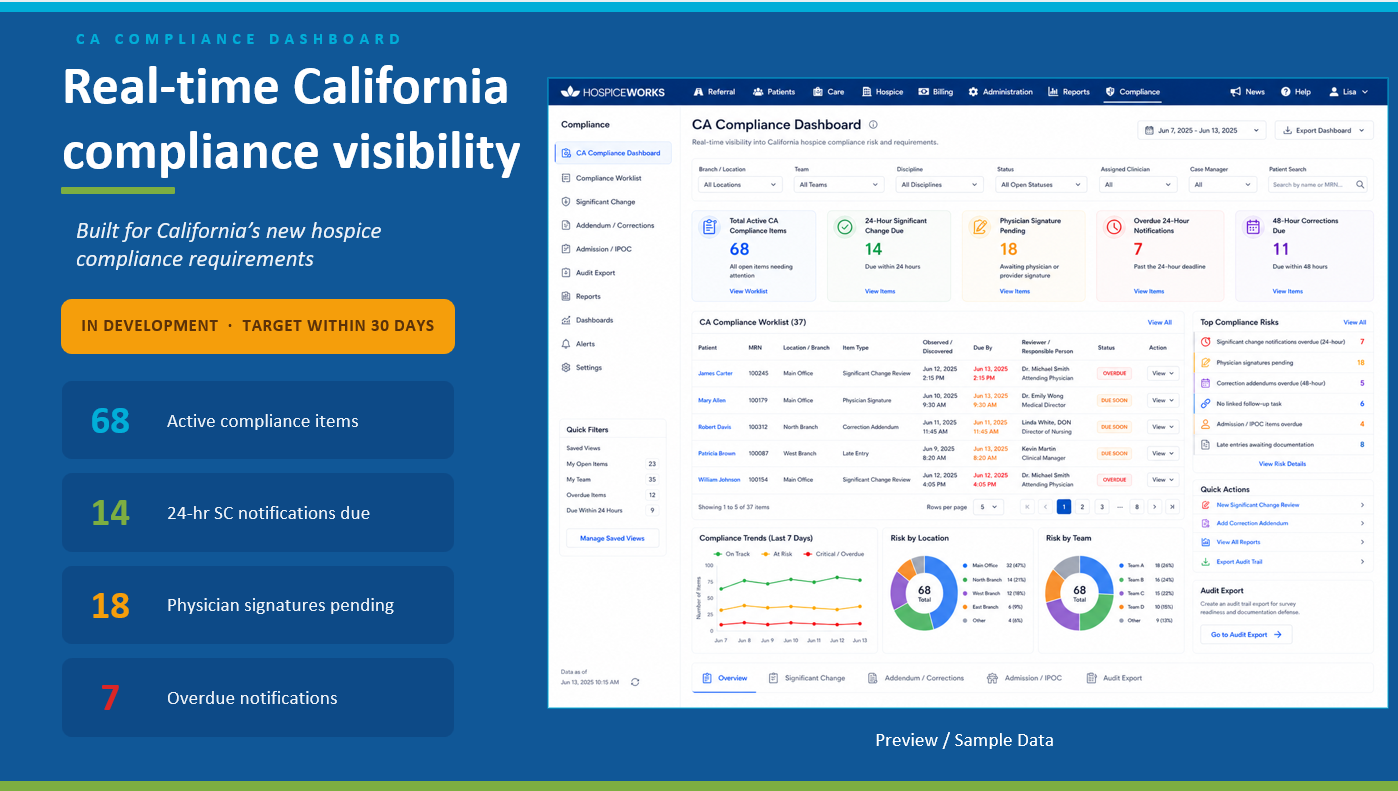
When a clinician documents a significant change, the system will automatically start a 24-hour physician notification clock. The dedicated SC Review form will capture change type, physician notified, method, time, and physician response — all as required fields. The CA Compliance Dashboard (Target Within 30 Days) will surface overdue notifications in real time so nothing falls through the cracks.
Structured Addendum Classification (Launching July 3, 2026)
The addendum workflow enforces classification by type. The original note is locked after signature. The 48-hour correction window is tracked automatically. Late corrections are flagged and documented exactly as Title 22 requires.
Physician E-Signature Enforcement (Launching July 9, 2026)
Physician e-signature will be required before an SC review is marked complete. Each signature will be timestamped, attributed to the specific physician, and linked to the triggering patient event. All pending signatures will be tracked across the census on the CA Compliance Dashboard (Target Within 30 Days).
CDPH Audit Trail Export (Launching July 9, 2026)
Patient-level audit trail export available in one click. Includes the full history of all addendums, corrections, signatures, and notifications — exportable at any time, not assembled manually when a surveyor is standing at the front desk.
CA Compliance Dashboard — Target Within 30 Days
Real-time visibility into every open compliance item across your agency — by location, team, discipline, clinician, and status. Overdue items in red. Approaching deadlines in amber. One-click CDPH audit export built in. The dashboard in the image above shows exactly what this looks like in practice.
California and Federal Pressure Are Hitting at the Same Time
Title 22 is not arriving in isolation. California hospices are managing state and federal compliance pressure simultaneously — on systems that were not designed for either.
At the federal level:
- HOPE replaced the Hospice Item Set on October 1, 2025, adding structured assessment timepoints, SFV triggers, and new iQIES submission requirements
- SSVI, introduced in the FY 2027 proposed rule, adds nine claims-based measures scoring your agency’s utilization and non-hospice spending patterns
- PPEO audits continue to drive pre-enrollment scrutiny nationally
- ADR activity is targeting eligibility documentation at every benefit period
Your EMR needs to handle California Title 22 and CMS HOPE in the same system. HospiceWorks is built to do both.
Before Your Next Survey: 8 Questions to Ask Your EMR Vendor
These questions apply to any EMR — including HospiceWorks. If your current vendor cannot answer them clearly, that is important information before your next CDPH window.
- When a clinician documents a significant change, does the system automatically start a 24-hour physician notification clock?
- Is there a dedicated SC Review form that captures change type, physician notified, method, time, and response — all as required fields?
- Does the system require and track physician electronic signature specifically on significant change reviews?
- When a documentation error is discovered, does the system enforce a 48-hour correction window and automatically flag late corrections?
- Are addendums classified by type — Correction, Late Entry, SC Follow-Up — with each as a separate signed record?
- Can you produce a patient-level audit trail showing every signature, addendum, correction, and physician notification in a single export?
- Is there a real-time compliance dashboard showing overdue notifications, pending signatures, and at-risk items across all patients?
- Was the system designed specifically for hospice compliance — or adapted from a general home health or EHR platform?
We will answer every one of these in a live demo — showing you exactly how HospiceWorks handles each requirement for your census, your team, and your next survey window.
Every Week on a Non-Compliant System Is a Week of Documented Risk
California’s Title 22 regulations took effect June 22, 2026. CDPH surveyors are enforcing them now.
The agencies that are in the strongest position going into their next survey are the ones that have been documenting compliance continuously — not the ones that updated their system in response to a citation.
HospiceWorks offers 21–30 day structured onboarding. A California hospice agency can be fully live and survey-ready following the July 9, 2026 production release of the automated Title 22 compliance engines. That means California-specific compliance configuration, data migration, role-based staff training, and a survey-readiness verification before go-live.
Frequently Asked Questions
What does California Title 22 require for hospice documentation?
California Title 22 (CCR §§74800–74908), effective June 22, 2026, requires hospice agencies to track 24-hour physician notification deadlines from the moment a significant change is documented, make all corrections as structured signed timestamped addendums classified by type within a 48-hour window, obtain and track physician electronic signatures on significant change reviews, and maintain a patient-level audit trail exportable on demand for CDPH surveyors.
What is the 24-hour notification requirement under California Title 22?
When a hospice clinician documents a significant change in patient condition, a 24-hour clock begins immediately. The hospice must notify the attending physician and document the exact time, who was notified, the method, and the physician’s response. A verbal notification without documented proof is not compliant. A missed window is a citable deficiency even if the care was appropriate.
Which hospice EMR is compliant with California Title 22?
HospiceWorks is purpose-built for hospice compliance with California-specific Title 22 workflows launching in production — including structured addendum classification (July 3, 2026), automated 24-hour SC notification tracking, physician e-signature enforcement, and one-click CDPH audit trail export (all July 9, 2026). HospiceWorks is HOPE-ready, HIPAA compliant, and built for today’s hospice compliance requirements.
How does Hospice Audit Guard Co-Pilot™ help with California compliance?
Hospice Audit Guard Co-Pilot™ reviews documentation before the clinician signs — surfacing recommendations around significant change triggers, eligibility gaps, care plan inconsistencies, and medication discrepancies in real time. The clinician remains in full control of all clinical decisions; Co-Pilot flags potential issues as recommendations, never as automated actions. Beginning July 9, 2026, Co-Pilot will also surface SC notification recommendations when documentation patterns suggest a potential significant change — helping clinicians catch compliance gaps before the 24-hour window is missed. The clinician reviews, decides, and signs with a stronger, more defensible record.
How quickly can a California hospice switch to HospiceWorks?
HospiceWorks offers 21–30 day structured onboarding. California hospice agencies can be fully live and survey-ready following the July 9, 2026 production release of the automated Title 22 compliance engines. Onboarding includes California-specific compliance configuration, data migration, role-based staff training, and a survey-readiness verification before go-live.
Does HospiceWorks handle CMS HOPE requirements as well?
Yes. HospiceWorks is fully HOPE-ready with complete HOPE assessment integration, iQIES data mapping, compliance timers, and automated file generation. California hospices are managing federal HOPE compliance and state Title 22 compliance simultaneously. HospiceWorks delivers both in a single hospice-native system.
This is the first article in our California Title 22 series. For a look at where EMR support for these requirements stands today, read our follow-up article: California Title 22 Hospice Compliance Is Now Measurable. Can Your EMR Prove It?
About the Author
Ramon Sanchez | Founder & CEO, HospiceWorks
Ramon Sanchez has been a driving force in senior healthcare since 2004. With over 22 years of experience as a hospice agency owner and software innovator, he has a deep understanding of the operational and clinical challenges facing hospice providers today. Before founding HospiceWorks, Ramon founded Greene Health Care Inc., a hospice solutions company where he worked directly with hospice owners, administrators, clinicians, QA teams, and operational leaders to navigate complex Medicare compliance and audit landscapes.
As the architect of Hospice Audit Guard Co-Pilot™ by HospiceWorks, Ramon leverages his decades of firsthand experience to help agencies move from reactive compliance to proactive documentation defense. His mission is to empower hospice teams with the technology they need to strengthen eligibility documentation, reclaim clinical capacity, and remain Survey-Ready in an era of increasing regulatory scrutiny.
Connect with Ramon on LinkedIn: https://www.linkedin.com/in/ramon-sanchez-009689165/
Sources
California Department of Public Health, “Emergency Regulations — Hospice Agency Licensing,” Title 22 CCR §§74800–74908, filed June 11, 2026, effective June 22, 2026.
California Governor’s Office, “Governor Newsom Signs Legislation to Combat Hospice Fraud,” January 2026.
Definitive Healthcare, “California Hospice Market Analysis,” November 2025.
CAHSAH Hospice Trends Report, 2023 Data.
CMS, “Hospice Outcomes and Patient Evaluation (HOPE) Technical Information,” effective October 1, 2025.
CMS, “FY 2027 Hospice Wage Index and Payment Rate Update and Hospice Quality Reporting Program Requirements,” April 2026.
CMS, “CMS Announces Aggressive Nationwide Crackdown on Fraud with Six-Month Hospice and Home Health Agency Enrollment Moratoria,” May 2026.